
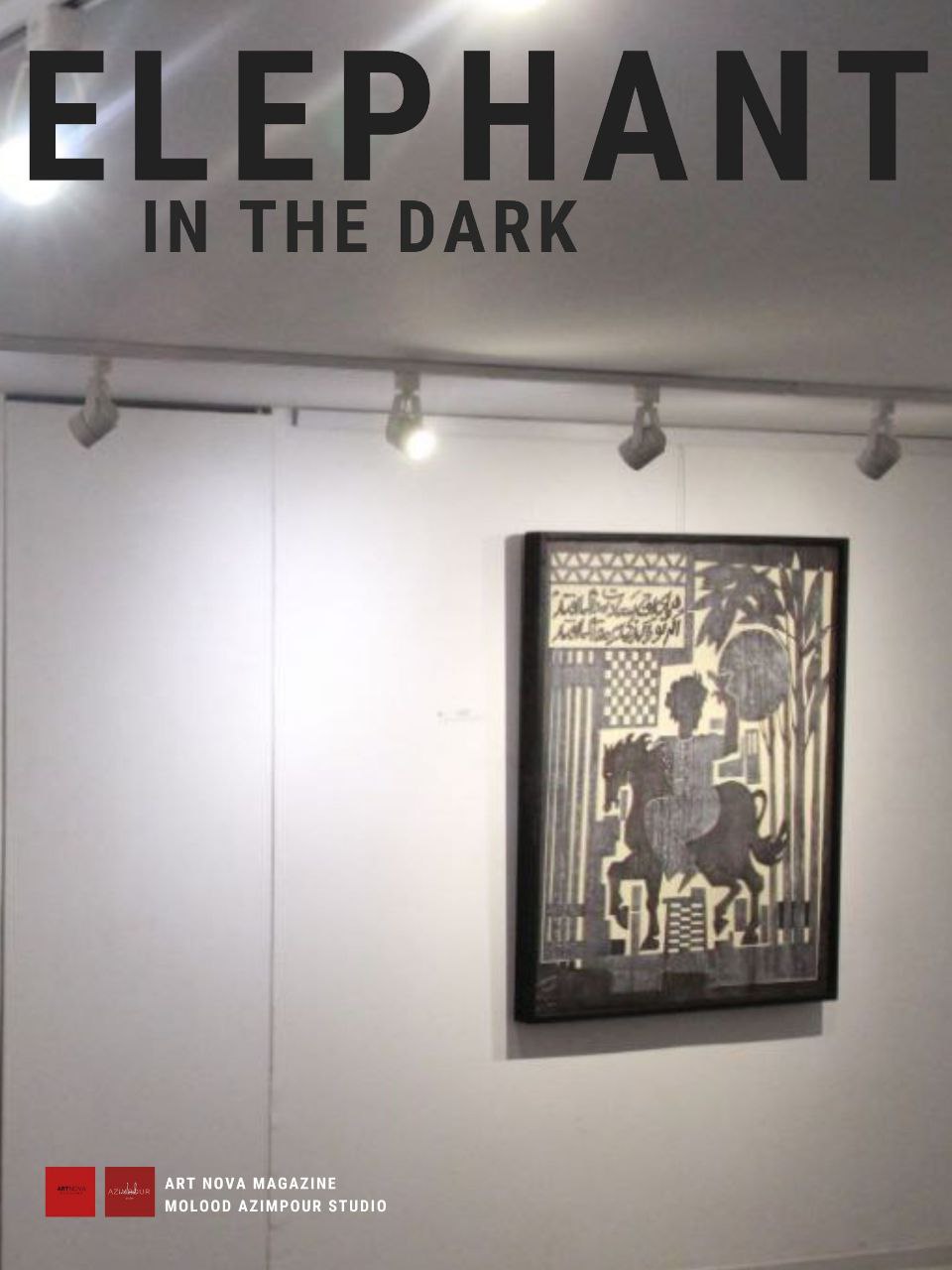
Featuring a work by Iraj Eskandari
Curated by Molood Azimpour – Seyhoun Art Gallery, Tehran
In this section of ELEPHANT IN THE DARK, the work of Iraj Eskandari stands as a powerful intersection of mythic symbolism, structural abstraction, and the layered history of Iranian visual culture. His painting, rooted in a refined balance between figuration and conceptual geometry, introduces a narrative dimension to the exhibition—one that bridges ancient archetypes with contemporary artistic inquiry.
Eskandari’s visual language, marked by precision, restraint, and symbolic density, resonates deeply with the exhibition’s central metaphor: the impossibility of perceiving the whole, and the fragmented nature of human understanding. His work becomes a lens through which the viewer encounters the tension between what is seen and what remains concealed.
Symbolic Figuration – The Rider, the Horse, and the Architecture of Myth
At the heart of Eskandari’s composition lies a stylized figure mounted on a horse—a motif that carries centuries of cultural, poetic, and historical resonance. Yet in his hands, this familiar symbol is transformed into a geometric and conceptual construct, stripped of narrative literalism and reimagined as a vessel for abstract meaning.
Conceptual Characteristics
– Geometry as Narrative
The figure and horse are rendered through controlled lines and structured forms, suggesting that myth itself can be understood as a system of shapes, codes, and visual logic.
– The Circular Emblem
The circular form held by the rider functions as a symbolic axis—an object that may represent time, destiny, or the cyclical nature of perception.
– The Fragmented Script
The text-like marks above the composition evoke the presence of language without offering legibility, reinforcing the exhibition’s theme of partial understanding.
Eskandari’s work does not tell a story; it constructs a symbolic architecture through which the viewer must navigate.
The Palette of Memory and the Weight of History
The muted, monochromatic palette—dominated by earthy tones, soft contrasts, and controlled shading—creates an atmosphere of historical depth.
The painting feels like an artifact unearthed from memory, yet simultaneously contemporary in its abstraction.
Key Elements
– Muted tones evoke the erosion of time.
– Textural restraint suggests a deliberate withholding of information.
– Symbolic clarity emerges through minimalism rather than detail.
This balance between presence and absence mirrors the exhibition’s conceptual foundation:
that truth is always layered, always incomplete, always shaped by what we cannot fully see.
A Curated Moment of Stillness and Interpretation
Within the broader architecture of Elephant in the Dark, Eskandari’s work introduces a moment of stillness, contemplation, and symbolic density.
It invites the viewer to slow down, to read the painting not as an image but as a coded field of meaning.
Placed within the exhibition’s conceptual flow, the work functions as:
– a bridge between abstraction and narrative,
– a dialogue between ancient motifs and modern sensibilities,
– and a reminder that perception is always mediated through cultural memory.
Significance Within the Exhibition
Eskandari’s contribution enriches the exhibition’s exploration of fragmented perception by grounding it in symbolic form.
His work demonstrates that even the most structured images contain layers of ambiguity—and that myth, like perception, is always reconstructed through the viewer’s limited vantage point.
This section reflects the curatorial vision of Molood Azimpour, who positions Eskandari’s painting as a conceptual anchor—an artwork that deepens the exhibition’s philosophical inquiry and expands its visual vocabulary.