
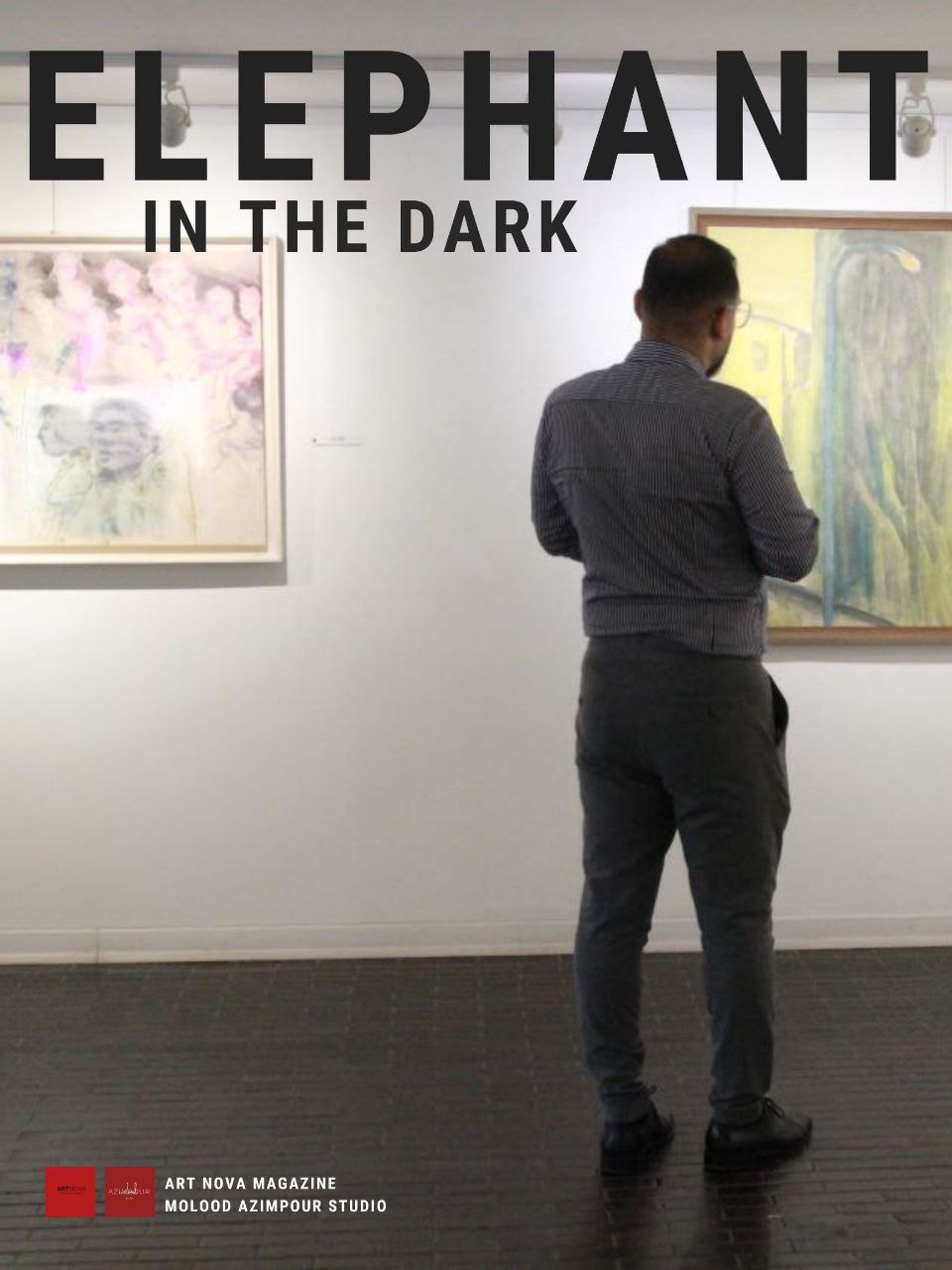
Featuring works by Ali Golestaneh (right) and Shahram Karimi (left)
Curated by Molood Azimpour – Seyhoun Art Gallery, Tehran
In this section of ELEPHANT IN THE DARK, two distinct artistic voices—Shahram Karimi on the left and Ali Golestaneh on the right—form a refined and conceptually layered dialogue. Their works, though emerging from different visual traditions, converge around the exhibition’s central metaphor: the fragmented nature of perception and the impossibility of grasping the whole.
Together, these paintings create a pivotal moment within the exhibition’s conceptual architecture, revealing how abstraction, memory, and emotional resonance illuminate different facets of the unseen.
Shahram Karimi – The Poetic Atmosphere of Memory and Emotional Space (Left Artwork)
The work of Shahram Karimi unfolds through soft chromatic transitions, atmospheric textures, and a poetic sensibility that bridges abstraction with emotional memory. His composition feels suspended—an image that hovers between emergence and disappearance, presence and recollection.
Conceptual Characteristics
– Color as Emotional Atmosphere
Karimi’s palette constructs a space where memory becomes visible through hue, softness, and subtle transitions.
– A Breathing Form
The painting expands outward like an internal landscape, suggesting a truth that is tender, ephemeral, and constantly shifting.
– The Liminal Zone of Perception
His work exists in the threshold between recognition and dissolution, echoing the exhibition’s central theme of partial illumination.
Karimi offers a vision of truth that is poetic, atmospheric, and emotionally resonant—a truth that reveals itself through softness rather than clarity.
Ali Golestaneh – Depth, Structure, and the Weight of the Unseen (Right Artwork)
In contrast, the work of Ali Golestaneh presents a more grounded, structured, and introspective visual field. His composition is built through layered forms, muted tones, and a density that invites slow, deliberate looking.
Conceptual Characteristics
– Layered Depth
Golestaneh’s use of texture and color creates a sense of sedimented time—layers of experience compressed into a single surface.
– Ambiguity as Structure
The forms resist full identification, existing in a space where meaning is suggested rather than declared.
– The Emotional Weight of the Unseen
His earthy, contemplative palette evokes the gravity of what lies beneath the surface—what is felt but not fully articulated.
Golestaneh’s work reveals a truth that is dense, layered, and introspective—a truth that must be uncovered slowly, through attentive perception.
A Curated Encounter – Two Visions, One Conceptual Field
Placed side by side, these two works articulate the dual nature of perception:
– Karimi reveals the emotional and atmospheric dimension of the unseen.
– Golestaneh reveals the structural and introspective dimension of the unseen.
Their juxtaposition embodies the core premise of Elephant in the Dark:
that truth is never singular, and each artwork offers only one touch, one angle, one fragment of the larger whole.
Significance Within the Exhibition
This pairing forms one of the exhibition’s most nuanced conceptual moments.
Here:
– abstraction becomes a shared language,
– color becomes a vessel for memory and depth,
– and the viewer moves between two modes of perception—soft expansion and grounded introspection.
This section exemplifies the curatorial vision of Molood Azimpour, who constructs a space where artworks do not merely coexist but actively converse, revealing the multiplicity of truths hidden within the darkness of perception.