
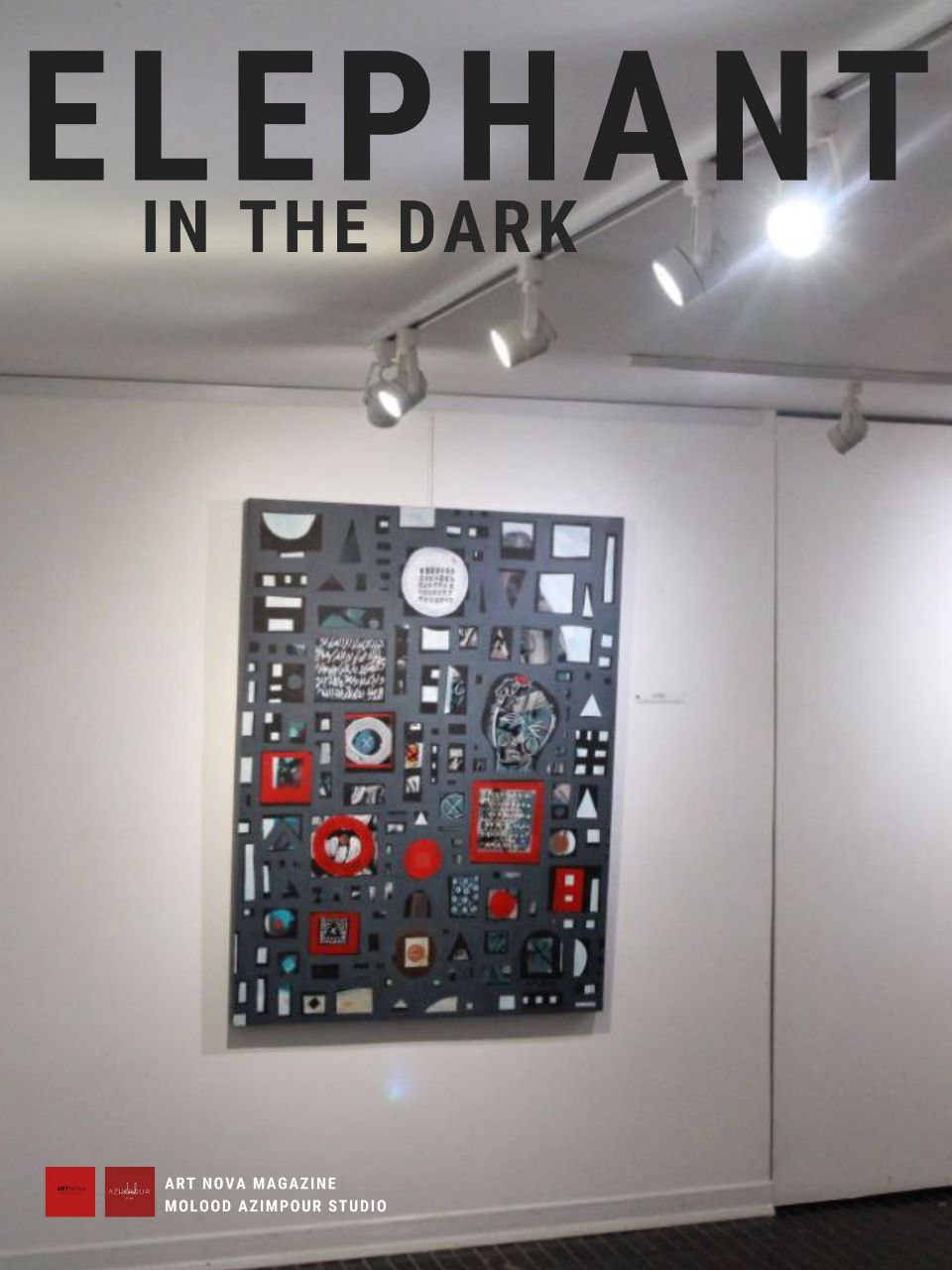
Featuring a work by Kayvan Asgari
Curated by Molood Azimpour – Seyhoun Art Gallery, Tehran
In this section of ELEPHANT IN THE DARK, the work of Kayvan Asgari introduces a powerful visual language grounded in structural clarity, symbolic abstraction, and a refined exploration of human presence. His composition—constructed through a grid-like architecture filled with geometric forms, coded symbols, and chromatic contrasts—stands as one of the exhibition’s most intellectually charged moments.
Asgari’s work resonates deeply with the exhibition’s central metaphor: the fragmented nature of perception and the impossibility of grasping the whole. Each square, circle, and patterned segment becomes a fragment of meaning—an isolated touch upon the larger “elephant” that remains unseen.
A Structured Field of Symbols and Perception
The painting unfolds as a meticulously organized visual matrix. Within this grid, Asgari orchestrates a dynamic interplay of shapes, colors, and coded motifs that evoke both modernist rigor and contemporary conceptual inquiry.
Conceptual Characteristics
– Geometry as Language
The grid becomes a system of thought—a visual syntax through which the artist constructs meaning. Each compartment functions like a word, a symbol, or a fragment of narrative.
– Color as Emotional and Structural Force
The interplay of reds, blacks, whites, and muted tones creates a rhythm that guides the viewer’s eye across the surface. Color becomes both an emotional register and a structural anchor.
– Symbolic Density
The presence of circles, triangles, abstract emblems, and text-like marks suggests a coded world—one that invites interpretation but resists full deciphering.
Asgari’s work does not offer a singular reading; instead, it proposes a field of possibilities, each fragment contributing to a larger, unknowable whole.
The Mask of Modernity – Between Abstraction and Identity
While the composition is rooted in abstraction, it carries an undercurrent of human presence. The grid, with its compartmentalized logic, can be read as a metaphor for the fragmented nature of contemporary identity—constructed through layers, symbols, and partial truths.
Key Elements
– Fragmentation as Identity
The painting suggests that identity is not unified but composed of multiple, sometimes contradictory, elements.
– The Tension Between Order and Ambiguity
The strict geometry contrasts with the ambiguity of the symbols within it, creating a dynamic tension that mirrors the exhibition’s conceptual foundation.
– A Contemporary Visual Archive
The work feels like a catalog of signs—an archive of visual memory, cultural echoes, and personal codes.
A Curated Moment of Precision and Inquiry
Within the broader architecture of Elephant in the Dark, Asgari’s work introduces a moment of intellectual clarity and conceptual density.
Its structured surface stands in contrast to the more atmospheric or gestural works in the exhibition, creating a necessary counterpoint that enriches the overall narrative.
Placed within the exhibition’s flow, the painting functions as:
– a map of fragmented perception,
– a system of symbolic thought,
– and a mirror reflecting the complexity of contemporary visual identity.
Significance Within the Exhibition
Asgari’s contribution deepens the exhibition’s exploration of partial vision by grounding it in a visual system that is both ordered and enigmatic.
His work demonstrates that even within the most structured frameworks, meaning remains elusive—constructed through fragments, symbols, and the viewer’s own interpretive lens.
This section reflects the curatorial vision of Molood Azimpour, who positions Asgari’s painting as a conceptual anchor—an artwork that expands the exhibition’s intellectual vocabulary and reinforces its philosophical inquiry.